




Delaney CDJR


Open Today! Sales: 9am-8pmService: 8am-4:30pm
The compact SUV aisle has quietly become a hybrid aisle, and that makes choosing harder rather than easier. The 2026 Jeep Cherokee returns fully redesigned and hybrid only, arriving against three of the most established names in the class: the 2026 Toyota RAV4, the 2026 Honda CR-V and the 2026 Mazda CX-50. Each one brings a real argument to the table, and each one asks a shopper to give something up. The question worth answering is which of these four delivers efficiency, capability and technology together, without pushing the important pieces onto an options sheet.
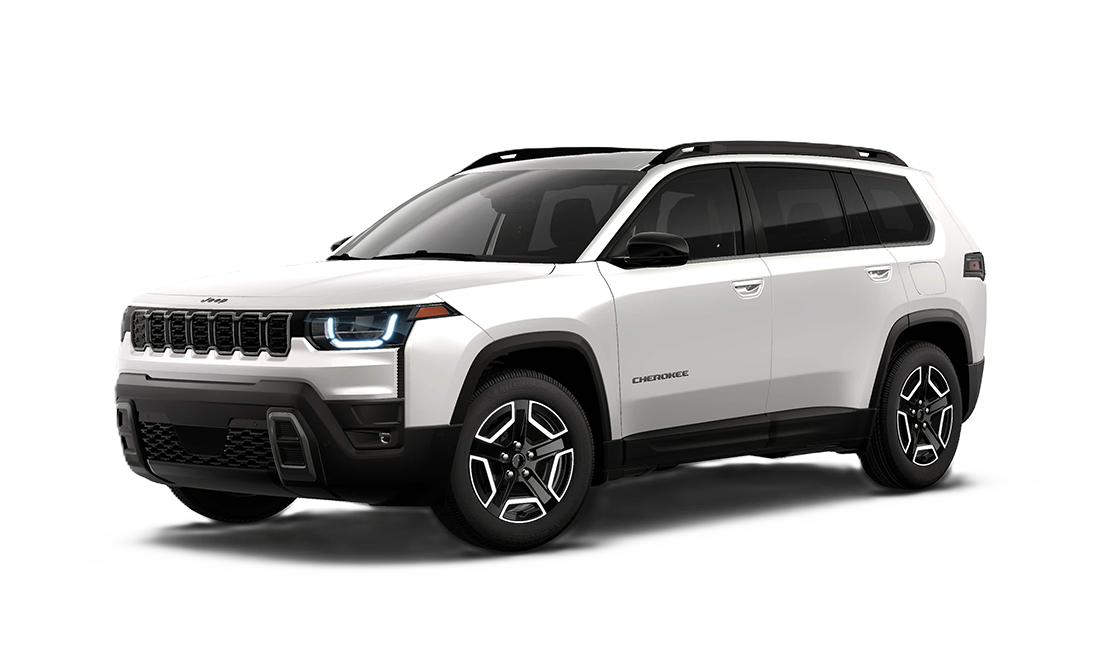
Every 2026 Cherokee uses the same turbocharged 1.6-liter hybrid powertrain, pairing the engine with two electric motors for a combined 210 horsepower and 230 lb-ft of torque through a continuously variable transmission. What matters more than the peak numbers is what comes attached to them. Four-wheel drive is standard on every trim, along with a rear-axle disconnect that decouples the rear wheels during light-load cruising, plus Selec-Terrain traction management with four driving modes for Auto, Sport, Snow and Sand or Mud. Jeep pairs that with 8 inches of ground clearance, an EPA-estimated 37 mpg combined and more than 500 miles of driving range on a tank, all without a charging cord.
The RAV4 is the horsepower leader here. Its hybrid system produces 226 horsepower with front-wheel drive and 236 horsepower with all-wheel drive, and the plug-in version climbs well past 300 horsepower with meaningful all-electric range. That is a genuine advantage, and shoppers chasing outright acceleration will feel it. The catch is configuration. Front-drive RAV4 models and the all-wheel-drive LE are rated to tow 1,750 pounds, and the 3,500-pound rating arrives only once a buyer moves up to a higher all-wheel-drive trim.
The CR-V splits the difference with a 190-horsepower turbocharged gas engine or a 204-horsepower hybrid, and its front-drive hybrid posts an excellent 40 mpg combined. Towing is where it falls behind: gas models are rated at 1,500 pounds and hybrids at 1,000 pounds, so a loaded utility trailer is off the table. The CX-50 counters with the most engaging chassis of the group and standard all-wheel drive on every trim, and its 219-horsepower hybrid returns 38 mpg combined. Its headline 3,500-pound tow rating, though, belongs to the turbocharged gas models rather than the hybrid.
That is where the Cherokee separates itself. Among these four, it is the one that pairs standard four-wheel drive, hybrid efficiency and a 3,500-pound tow rating in a single configuration. There is no drivetrain upgrade to select, no trim to climb to and no trade between efficiency and capability. The base Cherokee tows exactly as much as the top Cherokee.
The Cherokee reads as a Jeep from any angle, with a squared-off body, a seven-slot grille and a wider stance than the SUV it replaces. Inside, that width translates into real numbers: 41.3 inches of front legroom, 38.5 inches in the second row, and 40.3 and 40.2 inches of headroom front and rear on models without the dual-pane sunroof. That gives second-row passengers more stretch-out room than the RAV4, which measures 37.8 inches of rear legroom.
Cargo is where the group splits sharply. The Cherokee offers 33.6 cubic feet behind the second row and 68.3 cubic feet with the seats folded, which comfortably clears the CX-50 and its 31.4 and 56.3 cubic feet. It does not clear everyone. The CR-V leads this group for outright volume at 39.3 cubic feet behind the rear seats in gas form and 76.5 cubic feet folded, and the RAV4 lands at 37.8 and 70.4 cubic feet. Buyers whose single priority is raw cubic footage should look hard at the Honda.
For everyone else, the Cherokee makes a strong case on the way the space feels rather than the way it measures. Cabin materials climb from eco-friendly cloth to perforated Capri leatherette, the second row gets its own vents and a 60/40 split-folding bench, and a rotary gear selector frees up console storage. Available upgrades include a dual-pane sunroof, ventilated front seats, heated rear seats, a foot-activated power liftgate and premium audio, with the Overland trim carrying the most upscale material treatment in the lineup. The CX-50 counters with an unusually premium-feeling cabin for the class and strong trail geometry, with gas models offering between 8.3 and 8.6 inches of ground clearance depending on wheel size, so drivers who value polish and clearance over passenger volume have a real alternative.
Screen size is the cleanest comparison in this group, and the Cherokee wins it where it counts. Every trim, including the entry model, comes with a 12.3-inch Uconnect 5 touchscreen paired with a 10.25-inch digital cluster. The RAV4 starts at 10.5 inches, the CX-50 at 10.25 inches and the CR-V at 9 inches. Standard equipment on every Cherokee includes:
Higher trims layer on a 360-degree surround-view camera, a digital rearview mirror, a wireless charging pad and integrated navigation. It is worth being straight about the limits: that surround-view camera is an upper-trim option rather than standard equipment, and shoppers who want it will need to configure for it.
The competition is not standing still. Every RAV4 carries Toyota Safety Sense 4.0 along with a standard 12.3-inch digital gauge cluster, and its available 12.9-inch touchscreen is the largest display any of these four can be ordered with. The CX-50 makes blind-spot monitoring and adaptive cruise control standard across the range as part of its i-Activsense suite, and the CR-V includes Honda Sensing on every trim. What sets the Cherokee apart is that its full driver-assist package, including Level 2 lane centering, arrives on the least expensive trim in the lineup rather than several steps up the ladder.
The 2026 Jeep Cherokee is the winner of this matchup. The RAV4 makes more power and offers a bigger available screen, the CR-V hauls more cargo and sips less fuel in front-drive form, and the CX-50 is the most rewarding of the four to drive on a good road. Those are real strengths, and none of them are worth pretending away.
What none of them do is deliver the whole package in one configuration. The Cherokee is the only SUV here that hands every buyer standard four-wheel drive, a 3,500-pound tow rating, 37 mpg combined with over 500 miles of range, and the largest standard touchscreen in the group, with no upgrade required to unlock any of it. For a shopper who wants hybrid efficiency without surrendering capability, that combination is the argument, and it is one the Cherokee wins outright.
Specifications only tell part of the story, and the 2026 Cherokee lineup is best understood from the driver’s seat. Visit Delaney CDJR of DuBois in DuBois, PA to compare trims, explore the standard 4×4 hybrid powertrain and schedule your test drive today.