



Delaney CDJR


Open Today! Sales: 9am-8pmService: 8am-4:30pm
Shopping Ram trucks usually comes down to one question before any other: half ton or three quarter ton? The 2026 Ram 1500 and the 2026 Ram 2500 share a family resemblance and a lot of the same cabin technology, but they are engineered around very different jobs. One is built to live comfortably as a daily driver that tows on weekends. The other is built around a chassis, axles and cooling capacity meant for serious, repeated heavy work.
This is not a matter of one truck being better than the other. It is a matter of matching the truck to the trailer, the load and the miles you actually drive. Here is how the two compare across the categories that matter most, so you can figure out which side of the lineup you belong on.
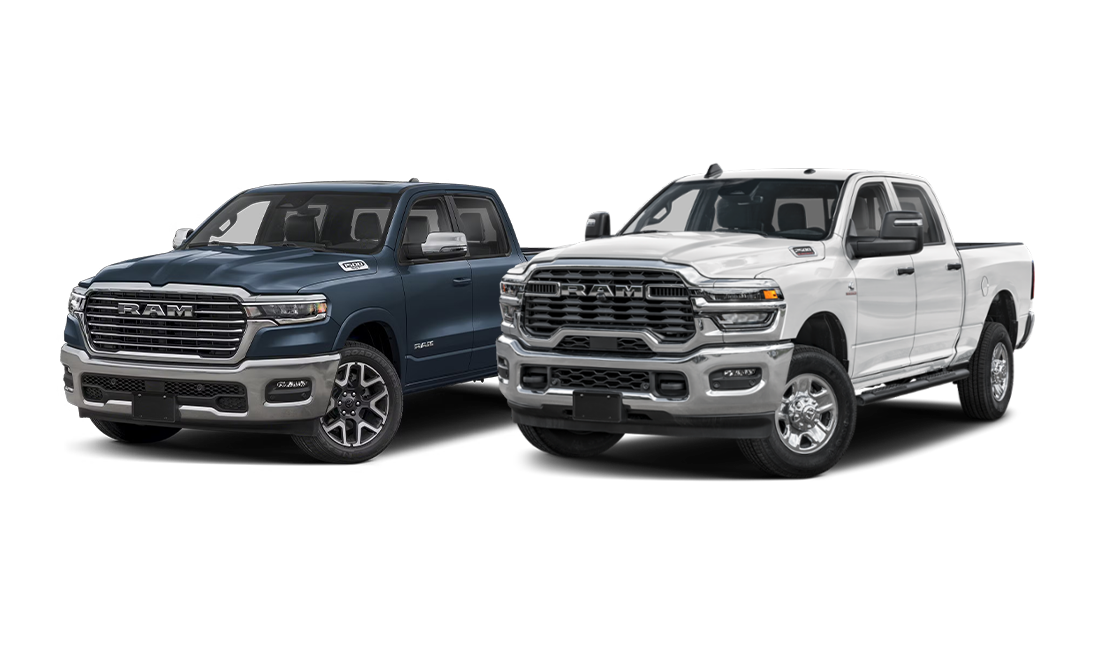
The engine lineups are where these two trucks separate most clearly. The 1500 offers a broad range of gas powertrains tuned for everyday driving and weekend towing. The 2500 offers two heavy duty engines built for sustained load.
2026 Ram 1500 Engine Lineup
The 1500 gives buyers four gas engine choices, and the right one depends on whether you prioritize payload, towing or outright output. Notably, the 5.7L HEMI V8 is available again on select 2026 models.
Worth noting for anyone doing the math: the configuration that maximizes towing is not the configuration that maximizes payload. The V6 carries the most weight in the bed, while the standard output Hurricane pulls the most trailer. All figures require proper equipment, and options, passengers and cargo all affect the final numbers.
2026 Ram 2500 Engine Lineup
The 2500 keeps it simple with two engines, both paired to an eight speed automatic transmission.
The pattern mirrors the 1500 in one respect: the gas engine is the payload choice and the diesel is the towing choice. The gap between the two trucks, though, is substantial. Maximum 2500 towing is roughly 8,400 pounds beyond the best the 1500 can manage, and maximum 2500 payload is more than 1,500 pounds higher. Maximum GVWR on the 2500 reaches 11,040 pounds on select configurations, which is a useful way to understand why the heavy duty truck can carry what it does.
Where Each One Makes Sense
If your trailer is a boat, a pair of side by sides, a small to midsize travel trailer or a single axle utility trailer, those loads sit comfortably inside the 1500 range. Once you move into large fifth wheel campers, gooseneck equipment trailers, livestock trailers or loaded dump trailers, you are in territory the 2500 was designed for. One detail worth knowing before you shop: on the 2500, a fifth wheel or gooseneck hitch is required for trailers over 20,000 pounds, and maximum tongue weight on the Class V receiver hitch is limited to 2,000 pounds.
How each truck rides when the bed is empty is one of the most practical differences between them, and it is the one buyers notice on the first test drive.
Here is something that surprises a lot of shoppers: both trucks use a coil spring rear suspension rather than leaf springs. The 1500 has standard rear coil springs, and the 2500 carries a Class-Exclusive coil link rear suspension of its own. Stepping up to the heavy duty truck does not mean accepting the harsh, leaf sprung ride that the three quarter ton segment is known for.
The difference is in how each is tuned. The 1500 is sprung for everyday comfort and is available with an Active-Level Four Corner Air Suspension System on Crew Cab models, which is why it drives much closer to a large SUV than a traditional pickup. The 2500 is sprung to carry and pull weight, so it feels firmer when the bed is empty and settles in once there is a load behind it. An available auto-level rear air suspension helps keep the truck sitting level with a heavy trailer or load on board.
Cab and bed choices also separate them. The 1500 is offered in Quad Cab and Crew Cab body styles, and Crew Cab models deliver expansive rear seat legroom at 45.2 inches. The 2500 offers a broader range of configurations: Regular Cab with an 8-foot bed, Crew Cab with either a 6-foot-4-inch or 8-foot bed, and Mega Cab with the 6-foot-4-inch bed. The Mega Cab adds a Class-Exclusive forward fold-flat rear seat, and Crew Cab models with the 8-foot bed can be equipped with a 50 gallon fuel tank, which matters on long hauls between fuel stops.
Off road buyers have choices on both sides. The 1500 lineup includes the Rebel, Warlock and RHO. The 2500 counters with the Power Wagon, which adds an electronic front sway bar disconnect, front and rear electronic locking differentials, Bilstein shocks, hill descent control and Goodyear all-terrain tires. A diesel engine option for the Power Wagon is also coming, with availability projected for the second half of 2026.
Both trucks carry Ram’s current cabin technology, so stepping up to the 2500 does not mean giving up creature comforts, and staying with the 1500 does not mean settling for less screen.
The 1500 offers more than 50 inches of combined available digital display area across the interactive digital cluster, head-up display, 14.5-inch touchscreen and front passenger touchscreen display. The 2500 offers a Largest-in-Class available 14.5-inch infotainment touchscreen of its own. Both are available with dual wireless charging pads.
Towing technology is where the two diverge by purpose rather than by quality. The 1500 offers an extensive set of trailering features, including an Integrated Trailer Health Monitor, Trailer Reverse Guidance with Dynamic Gridlines, Trailer Hitch Line-Up Assist and a Digital Rearview Mirror with Tow Mode. The 2500 adds heavy duty specific tools such as Trailer Reverse Steering Control, available trailer tire pressure monitoring for up to four trailers, and an available Fifth-Wheel/Gooseneck Prep Package with a factory installed rear axle structural crossmember.
On the safety side, the 1500 is offered with more than 100 standard and available safety and security features, including Evasive Steering Assist, Intersection Collision Assist, Drowsy Driver Detection and Traffic Sign Recognition, plus available Hands-Free Active Driving Assist. The 2500 answers with Class-Exclusive standard Adaptive Cruise Control, standard Forward Collision Warning Plus with automatic emergency braking and standard Trailer Brake Control, plus available Blind Spot Monitoring with trailer coverage and Lane Keep Assist with Adaptive Steering. On the hardware side it adds heavy duty four wheel disc antilock brakes and an available automatic smart exhaust brake, which helps control speed on long grades with a trailer behind you. Snowplow Prep, including a 220 amp alternator and snowplow prep wiring, comes standard on the 2500.
Specific features vary by trim and package on both trucks, so confirm availability on the exact configuration you are considering.
Neither truck is the default answer. The honest way to choose is to start with the heaviest thing you will tow or haul on a regular basis, not the heaviest thing you might tow once.
The 2026 Ram 1500 is likely the better fit if:
The 2026 Ram 2500 is likely the better fit if:
A useful rule of thumb: if you find yourself hoping your numbers will fit, you probably want the next truck up. If you have real margin on both towing and payload, the 1500 will serve you better the other six days of the week.
The surest way to settle the half ton versus three quarter ton question is to drive both back to back and see how each one feels in your hands. Our team can also walk through your trailer weight, hitch setup and axle ratio to make sure the configuration you order actually matches the work you do.
Visit Delaney CDJR of DuBois in DuBois, PA to compare the 2026 Ram 1500 and 2026 Ram 2500 side by side and schedule your test drive.